The digital search ecosystem is undergoing its most radical transformation since the invention of Google. We have shifted from an era focused on ranking blue links (traditional SEO) to one dominated by answer engines (AEO: Answer Engine Optimization) and generative engine optimization (GEO: Generative Engine Optimization).
Today, tools like Gemini, ChatGPT, Perplexity, Claude, and Google AI Overviews synthesize direct answers for users. If your website’s technical architecture is not designed for Large Language Models (LLMs) to read, extract, and cite it correctly, your brand is excluded from the response.
What Does a Website Need to Be Readable by LLMs?
For a language model to extract your content and cite your company as an authoritative source, your web architecture must meet five essential technical pillars:
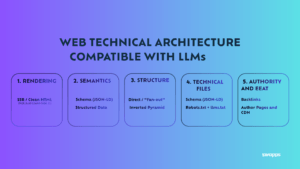
1.1. Guarantee Server-Side Rendering (SSR): Critical for AI bot indexing.
Artificial intelligence crawlers (such as ChatGPT-User or PerplexityBot) do not interact with complex client scripts or execute JavaScript extensively. If your pricing, services, or key answers rely on browser rendering (Client-Side Rendering), they simply do not exist for the AI. All critical information must be delivered directly within the server’s HTML.
2.2. Implement Schema Structured Data (JSON-LD): Direct translation of content for machines.
Schema it is the interpreter that explains the relationship between entities to the AI. The architecture must include rigorous Organization, Product, FAQPage, and Article markups in JSON-LD to connect your corporate entity with your solutions.
3.3. Enable ‘llms.txt’ and Adjust CDN/Robots Directives: A clean path for AI agents.
Just as robots.txt guides traditional search engines, the emerging llms.txt standard provides a simplified Markdown file specifically designed for models to process your business context without consuming unnecessary tokens on menus or residual code.
Additionally, you must verify that firewalls and CDNs (like Cloudflare) are not blocking legitimate AI bots.
4.4. Structure Content Under the ‘Answer-First’ Model: AEO/GEO content optimization.
Retrieval-Augmented Generation (RAG) systems fragment your site into blocks (chunks). Content should use the inverted pyramid technique: providing a clear, direct answer within the first 2–3 sentences before going into deeper detail.
5.5. Authority and E-E-A-T (Author Pages and CDN): Validating trust and accessibility.
Language models (LLMs) read text while also evaluating the reliability and provenance of the information using RAG algorithms and Google’s E-E-A-T guidelines (Experience, Expertise, Authoritativeness, and Trustworthiness) to ensure an LLM safely selects and cites your content.
CDN Security/Availability preventing 503 errors or firewall blocks from Cloudflare that make LLMs discard your site instantly.
How Swapps Helps Modernize Your Web Platform
At Swapps, we combine more than 13 years of experience in software maintenance, systems architecture, and advanced web development with SEO, AEO, and AI integration strategies to ensure that websites appear among the top search results and, of course, technical web architecture for LLMs.
- Custom Development and Re-architecture: At Swapps, we transform slow or client-rendered sites into ultra-fast platforms powered by Server-Side Rendering (Next.js, Nuxt, or custom architectures), ensuring generative engines can read every single word.
- Implementation of AEO/GEO Standards: We design and integrate advanced Schema markups, llms.txt files, and APIs that serve your information in optimized formats for conversational agents.
- Infrastructure and Continuous Web Maintenance: We monitor your endpoints, security directives, and network configurations to keep the doors open to AI without compromising security.
- Specialized Technology Consulting: We evaluate your platform’s current state to reduce technical friction and position your brand as the industry baseline.
- Best Practices Monitoring for Content and Structure: We stay vigilant to ensure that keywords and necessary elements are easily accessible so audiences who don’t know your brand can find your site smoothly.
User Guide: How to Test If Your Web Is Readable by LLMs
Follow these practical methods to diagnose whether your website is losing visibility in response engines like ChatGPT, Perplexity, or Google AI Overviews.
The “Direct Source Code” Test (The AI Filter)
AI crawlers extract the initial flat HTML sent by your server. If your content relies on browser-executed JavaScript, AI agents will see a blank page.
- Go to a key page on your website (e.g., your primary service).
- View your page’s source code.
- Search for a core phrase or keyword of your service.
- What do the results mean?
- Passed (Correct SSR): Your text appears immediately, wrapped in legible semantic tags like <h1>, <h2>, or <p>.
- Points to Fix: You cannot find your text, or you only see empty containers (<div></div>) and massive blocks of JavaScript code. The AI cannot read you.
Control File Audit (robots.txt and llms.txt)
If your doors are locked, no artificial intelligence agent will index your content, no matter how good it is.
- Go to [yourdomain.com/robots.txt].
- Check for Disallow: / lines associated with agents like GPTBot, PerplexityBot, ClaudeBot, or Google-Extended. If blocked, correct them immediately.
- Go to [yourdomain.com/llms.txt]: It should display a clean summary of your business in Markdown format. A 404 error means your architecture has not yet adapted to the generative search engine standard.
Reverse Engineering with ChatGPT, Gemini, Claude, etc.
Directly evaluate an LLM’s “understanding” of your site by simulating a manual RAG process.
- Open your preferred AI tool.
- Copy the HTML source code of your web page or enter the URL directly if the model has active web browsing enabled.
- Input the following test prompt:
“Act as an answer engine (AEO). Analyze the following text/URL and extract the company’s top 3 services, who backs the information, and its value proposition. If there is missing data, confusing details, or unnecessary code wasting tokens, please point it out.” - What do the results mean? The model will mirror exactly what it interprets. If it confuses your services or cannot find the author of the article, your semantic structure and E-E-A-T are failing.
Next Steps: What to Do If Your Site Fails the Tests
If your website is not optimized for the LLM era, your infrastructure requires professional technical intervention:
- Migrate to Server-Side Rendering (SSR) Environments: If your site uses modern frameworks but is configured as a traditional Single Page Application (SPA), it is urgent to migrate to frameworks that support native SSR (such as Next.js or Nuxt).
- Generate the AI Map File (llms.txt): You can create a structured Markdown file at the root of your server to serve as a high-priority index for bots.
- Configure Firewall Access: Adjust your CDN perimeter rules (such as Cloudflare) to allow legitimate AI bot crawling while blocking malicious scrapers.
- Implement Structured Data Routing: Link each of your business solutions to validated web entities (author profiles, corporate brand registries) using Schema markup.
Did your website fail the AI reading tests?
At Swapps, we transform your web platform’s technical architecture, removing the code barriers that hide your business from language models. Contact us at Swapps.com for an in-depth technical AEO and GEO audit and optimization.
The Present of Brand Visibility Belongs to Technical Architecture
The transition from traditional SEO toward the AEO and GEO ecosystem is a paradigm shift in how the world consumes information. It is no longer enough to design attractive web pages for human eyes; today, your first and most critical client is a Large Language Model (LLM).
If your website’s technical infrastructure isn’t optimized with server-side rendering (SSR), clear Schema semantics, “Answer-First” formats, and AI-friendly network configurations, your business may become invisible in the generative responses from platforms like Gemini, ChatGPT, Perplexity, or Google AI Overview –and that’s like not existing in the market.
Optimizing your web architecture with SEO, AEO, and GEO for large language models (LLMs) with technical web architecture for LLMs boosts your brand, ensuring that it’s not only read but also cited as a reference source within your industry. At Swapps, we turn the complexity of optimization into a tool that helps you become a strong competitor.
If you’re ready, contact us, and we’ll address your concerns.