Agentic AI: The Next Frontier Beyond Traditional Automation
Over the last few years, AI automation has focused primarily on well-defined, isolated tasks –such as generating code, drafting copy, or suggesting text edits. However, in 2026, the landscape has fundamentally shifted. We are no longer just talking about “assistants” that offer recommendations; businesses are looking at AI agents capable of executing end-to-end processes, making real-time decisions, and collaborating with one another with minimal human supervision.
This paradigm shift is what the industry defines as agentic AI workflows. It is rapidly establishing itself as one of the most critical trends of the year for both product development and business operations.
What Exactly Are Agentic AI Workflows?
Unlike traditional AI models that simply answer a prompt or generate a snippet of code on demand, agentic AI workflows leverage autonomous agents that can:
- Plan a strategic sequence of steps to achieve a specific business objective.
- Execute actual operations within real systems (such as deploying code, updating databases, generating reports, or escalating tickets).
- Monitor outcomes and dynamically adjust their own behavior if an error occurs.
- Coordinate seamlessly with other agents or tools without requiring constant human intervention.
Essentially, we are moving from an AI that merely suggests to an AI that acts—while always operating within boundaries defined by your team.
Drivers of Adoption in 2026
Three main factors are driving the accelerated adoption of these workflows this year:
- Matured Trust: Development and operational teams already trust AI as a co-pilot. The natural next step is delegating entire workflows rather than line-by-line tasks.
- Infrastructure Readiness: Modern frameworks for agent orchestration handle context far better than before. Additionally, emerging web-to-AI communication standards have made what was once experimental highly viable for enterprise use.
- The Scale vs. Headcount Dilemma: Organizations face intense pressure to accelerate delivery speeds and scale technical support without exponentially increasing headcount.
This final point is where agentic AI workflows transition from an interesting technical innovation into a powerful lever for operational scale.
From Task Automation to Autonomous Operations
There is a fundamental difference between automating a single task and running a process autonomously:
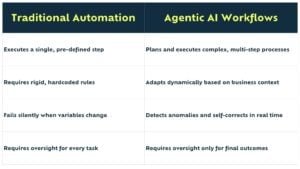
For leaders managing digital products, the operational implications are clear. Technical support, application maintenance, infrastructure monitoring, and quality assurance can now run continuously under the care of proactive agents, rather than waiting for a human to trigger them.
Strategic Risks Every Leader Must Manage
Adopting agentic AI workflows without a clear governance framework carries real business risks:
- Loss of Traceability: If an agent makes an operational decision, leaders must be able to audit why the agent made that choice.
- Amplified Bias & Errors: An autonomous agent operating at scale can replicate and amplify an error much faster than a human employee.
- Skill Erosion: Delegating too much authority without human-in-the-loop controls can degrade your internal team’s critical decision-making skills over time.
We do not emphasize “automate everything.” Instead, leadership must determine which decisions can be safely owned by an agent and which require human sign-off. Balancing speed with operational control is exactly why companies partner with experienced technical experts rather than simply plug in off-the-shelf tools.
A Responsible Framework for Deployment
If your organization is evaluating how to implement agentic AI workflows, a risk-mitigated approach looks like this:
- Start with low-risk, high-volume processes: Prioritize tasks such as support ticket triage, automated report generation, or basic performance monitoring.
- Define clear guardrails: Explicitly establish what the agent can execute autonomously and what strictly requires human approval.
- Ensure comprehensive auditing: Log every single action taken by an agent to ensure full accountability and visibility.
- Measure business outcomes, not just activity: Shift metrics from “how many tasks were automated” to concrete impacts on resolution times, service continuity, and customer satisfaction.
Swapps and Agentic AI
At Swapps, we view agentic AI workflows as a powerful value layer built upon a foundation we have always championed: integrating product development, intelligent automation, and continuous operations into a cohesive strategy, rather than treating them as isolated silos.
We deliver this through three distinct strategic fronts:
- Automation-First Product Design: When we build or scale a digital product, we analyze from day one which workflows are optimal candidates for autonomous agents (such as monitoring or data syndication) and which must remain under human control to protect quality.
- Expert Oversight as a Safeguard: AI agents accelerate repetitive work, but high-level decisions regarding architecture, data security, and user experience remain firmly in the hands of senior engineers who understand your business.
- Operations Built to Scale Frictionless: Agentic automation only delivers value if it moves your core business metrics. Our focus is never on “how much AI” we can deploy, but on the measurable operational impact it drives—like reduced response times and seamless uptime.
For us, agentic workflows are an accelerator within a broader strategy focused on product stability and sustainable growth—not a standalone cure-all.
Where Technology Meets Business Strategy
The ultimate goal of agentic AI workflows is not to replace a skilled technical team, but to redefine how your team manages and scales processes. The true value materializes when these autonomous agents are integrated into a mature operational design, supported by experts who know exactly when to trust automation and when to step in.
This is where modern web development, intelligent automation, and operational scale converge. The choice isn’t between humans or software; it’s about designing the right ecosystem where both work together seamlessly.
Is your team evaluating how to introduce AI agents into your business operations without risking quality or control? Let’s connect to design an agentic workflow tailored to your product.
Frequently Asked Questions
How do agentic AI workflows differ from traditional automation?
Traditional automation follows rigid, pre-set rules for isolated tasks. Agentic AI workflows can plan and execute multi-step sequences, adapt to changing context, and self-correct errors without needing a human to restart the process.
Is an AI agent the same as a chatbot?
No. A chatbot is designed to converse and answer questions. An AI agent can interact directly with production systems – executing changes, updating records, escalating technical support tickets, or autonomously monitoring infrastructure.
Is it safe to let an AI agent make decisions autonomously?
It depends entirely on the scope of the decision. The industry best practice is to define strict guardrails beforehand, outlining which tasks require human sign-off and maintaining a comprehensive audit log of every automated action.
What processes are the best starting points?
High-volume, low-risk operations are ideal. Examples include support ticket triaging, system performance monitoring, and standard data reporting. Critical core business processes should only be targeted once your infrastructure matures.
Do agentic AI workflows replace technical teams?
No. They eliminate low-value, repetitive tasks, allowing your engineering and operations teams to focus on high-leverage challenges like system architecture, data security, and user experience.