If you are thinking about creating or redesigning a website, it is essential to understand the type of website that is right for growth, scalability, and conversions. At Swapps, we present the 11 most relevant types of websites in the age of automation, artificial intelligence, and no-code, based on impact on business.
Today, a web page can be:
- A sales engine
- A SaaS platform
- A marketplace ecosystem
- An AI-powered experience
- A subscription business
How Web Pages Are Classified Today
Traditionally, web pages were classified into three main groups. While this classification is still useful from a technical perspective, modern web architecture has evolved significantly.
1. Static Web Pages
Static web pages are built using HTML and display fixed content.
They:
- Loads very fast
- Do not change unless manually updated
- Do not require a database
Today, static pages are often generated with modern frameworks (such as static site generators) and deployed via CDN infrastructure for high performance.
They are ideal for:
- Informational pages
- Micro-sites
- Documentation
- SEO-focused content
However, static does not mean “basic.” Even static pages today can integrate analytics, personalization scripts, and API-based content blocks.
2. Dynamic Web Pages
Dynamic web pages generate content in real time.
Historically, this meant animations with CSS or technologies like Flash (now obsolete). Today, dynamic pages include:
- Database-driven content
- News
- User-specific dashboards
- Interactive components
- Personalized product recommendations
- AI-driven content rendering
Dynamic pages are now powered by:
- JavaScript frameworks
- Headless CMS
- Cloud-based backends
- AI personalization engines
Most modern business websites fall into this category.
3. Client-Server Web Applications
These pages go beyond displaying content — they allow users to interact with backend systems.
They include:
- Authentication systems
- Payment processing
- Data management
- API integrations
- SaaS dashboards
Built using technologies like:
- Node.js
- React / Angular
- Python frameworks
- Cloud-native architectures
Today, this category includes:
- SaaS platforms
- Marketplaces
- Web applications
- Membership portals
These are no longer just “web pages” — they are full digital products.
The Modern Layer: AI, Personalization & No-Code
Web classification goes beyond static and dynamic. Modern web pages may also include:
AI-Powered Personalization
Websites can now:
- Recommend products dynamically
- Provide conversational UI experiences
- Automate onboarding flows
AI-native websites are designed to learn and improve conversion rates over time.
No-Code and Low-Code Development
Another major evolution is how web pages are built.
No-code and low-code platforms allow businesses to:
- Launch MVPs quickly
- Create landing pages without developers
- Automate workflows visually
- Validate product-market fit faster
However, as traffic, complexity, and integrations grow, many businesses migrate toward:
- Custom development
- Headless architecture
- Scalable infrastructure
- Advanced AI integrations
The key is choosing the right approach for your growth stage.
The 7 Most Powerful Types of Web Pages Today
1. E-commerce Websites
E-commerce websites remain one of the most profitable types of web pages.
Modern e-commerce now includes:
- AI-driven product recommendations
- Subscription models
- Headless commerce architecture
- Marketplace integrations
- CRO-optimized product pages
Amazon, Mercado Libre, Nike.com, Zara.com. They sell products directly with shopping carts, payments, and integrated logistics.
These websites are built not just to sell — but to scale.
Best for:
- Retail brands
- DTC companies
- Subscription product businesses.
2. SaaS Platforms (Software as a Service)
SaaS platforms combine a marketing website and a web application into a single ecosystem.
They typically include:
- User dashboards
- Account management
- Recurring billing
- API integrations
- Knowledge base/help center
SaaS websites are central to the subscription economy.
Best for:
- Tech startups
- B2B software companies
- Automation tools
Salesforce, HubSpot, Notion, Slack, Canva. Users pay a subscription fee to achieve a business goal and access the tool from their browser.
3. Landing Pages
Landing pages are built for one purpose: conversion.
In 2026, high-performing landing pages are:
- CRO-driven
- A/B tested
- Personalized dynamically
- Integrated with CRM and automation
- Optimized for paid traffic and SEO
They are essential for lead generation and product launches.
Best for:
- Campaigns
- SaaS trials
- High-ticket services
- Product releases
4. Marketplace Websites
Marketplace websites connect multiple buyers and sellers.
Core features:
- Vendor dashboards
- Commission logic
- Escrow payments
- Ratings and reviews
- Search & filtering systems
Marketplaces are complex — but highly scalable business models.
Best for:
- Service platforms
- Multi-vendor ecommerce
- B2B ecosystems
5. Web Applications
Unlike traditional informational pages, web applications allow users to perform actions.
Examples:
- Booking systems
- CRMs
- Financial dashboards
- Project management tools
They require backend logic, authentication, and scalable infrastructure.
Best for:
- Operational platforms
- Internal tools
- SaaS extensions
6. Membership Websites
Membership websites restrict content to registered or paying users.
They may include:
- Tier-based access
- Community features
- Recurring payments
- Premium content libraries
- AI-driven onboarding
Ideal for:
- Learning platforms
- Digital communities
- Exclusive content creators
7. Blog (SEO & Authority Engine)
A blog remains one of the most strategic types of web pages for long-term growth.
Modern blogs are:
- Structured for Answer Engine Optimization (AEO)
- Built with schema markup
- Designed for semantic SEO
- Connected to conversion funnels
A blog drives organic traffic that feeds ecommerce, SaaS, or service-based businesses.
Best for:
- Authority building
- SEO positioning
- Lead nurturing
Other Important Types of Web Pages
These types remain useful depending on your business model:
8. Portfolio Web Pages
Used to showcase creative work, case studies, or projects.
9. Informative Web Pages
Educational or research-focused websites without direct commercial intent.
10. Event Web Pages
Built for conferences, weddings, product launches, or corporate events.
11. Non-Profit Web Pages
Designed to promote causes, collect donations, and manage volunteers.
How to Choose the Right Type of Web Page
Why This Matters
What type of web page is best for a business?
It depends on the business model. E-commerce works for selling products, SaaS platforms for subscription software, marketplaces for multi-vendor ecosystems, and landing pages for lead generation.
The right type depends on:
- Your monetization model
- Your growth goals
- Your need for automation
- Your scalability requirements
- Your audience behavior
Many businesses combine several types:
- SaaS + Landing pages + Blog
- Ecommerce + Subscription + Knowledge base
- Marketplace + Community features
Do you sell a physical product? → E-commerce
Do you sell access to a tool? → SaaS
Do you connect buyers with third parties? → Marketplace
Is your goal to capture leads? → Landing Page
Do you want to position yourself on Google in the long term? → Blog
The key is not choosing the most complex option — but the one aligned with your strategy.
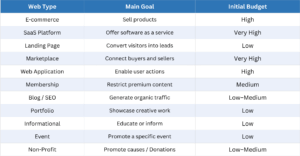
This table provides an overview of the types of pages available depending on your objective. A low budget can start at $1,000, while a high budget can exceed $20,000. This initial budget depends on the size of your business.
What is the difference between a website and a web application?
A website primarily provides information. A web application allows users to interact with it, perform tasks, manage accounts, or access services dynamically.
Final Thought
Currently, a web page is no longer just a digital brochure. It is a business model. Choosing the right type of web page can determine whether your company simply exists online — or scales.
If you’re evaluating what type of web page your business needs, the Swapps team can help you design and build a scalable, AI-ready digital architecture aligned with your growth goals.
Visit Get Swapps and start building the right foundation today.
Related blogs:
Custom Web Development: What Does Your Company Need?
Web performance: meaning and importance