
Digital transformation has become the ideal growth model for organizations across all sectors, from startups to established medium-sized companies and NGOs with a specific mission. Everyone wants to harness the superpower of AI. But here’s the crux of the matter: it’s a challenge to make digital transformation successful, to ensure it doesn’t underperform, and to prevent it from failing outright.
The culprit? It’s rarely the technology itself.
The Foundation Problem
AI doesn’t fail. Bad architecture does.
Consultant enterprises ensure that many organizations rush into AI adoption, seduced by promises of automation, predictive analytics, and competitive advantage. They invest in cutting-edge tools, hire data scientists, and launch pilot projects. Yet within months, the excitement fades as reality sets in.
This objective is good, but without scalable, well-designed systems as a foundation, even the most sophisticated AI initiatives crumble:
- AI can slow teams down rather than accelerate them. Data means endless integration work. Legacy systems can’t handle the computational load. Teams spend more time troubleshooting infrastructure than generating insights.
- Costs explode beyond initial projections. What started as a focused investment balloons as organizations discover they need to retrofit entire technology stacks. Cloud could be bills skyrocket. Consulting fees multiply.
- Insights arrive too late to matter. By the time your AI models process data through fragmented systems, market conditions have shifted, customer needs have evolved, or competitors have already moved.
What You Need to Know
For technical leaders, and decision makers, this challenge is very familiar. You’re balancing pressure from the board to innovate with operational realities on the ground. You know that bolting AI onto inadequate infrastructure is like building a skyscraper on a cracked foundation – it’s not a question of if it will fail, but when.
For CEOs and Marketing Directors, the strategic implications are clear: digital transformation isn’t just an IT project. It’s a fundamental business capability that determines whether your organization can adapt, compete, and grow in an AI-driven world.
Is AI-Ready Architecture Approach?
Yes, success requires inverting the typical approach. Instead of asking “What AI can we implement?” start with “What architecture do we need to make AI actually work?”
AI-ready architectures in the market are built with several core principles:
Scalability from day one. Systems designed to handle today’s data volumes and tomorrow’s exponential growth without costly rebuilds.
Integration-first thinking. Breaking down data so information flows seamlessly across departments, tools, and platforms.
Flexibility for evolution. Technology stacks that adapt as AI capabilities advance and business needs shift, without requiring complete overhauls.
Cost transparency. Clear visibility into resource consumption so AI investments scale economically, not exponentially.
For NGOs working with planned budgets, this approach means maximizing impact per dollar. For startups racing to product-market fit, it means building once and scaling fast. For mid-sized enterprises competing with larger players, it means punching above your weight class with technology leverage.
Building for Growth, Not Just Implementation
The organizations that succeed with digital transformation share a common trait: they design architectures that support AI, rather than forcing AI to work around architectural limitations.
This means involving technical architecture discussions early in strategy conversations. It means allocating sufficient resources to infrastructure, not just flashy AI features. It means measuring success not by the number of AI tools deployed, but by the business outcomes enabled.
At Swapps, we’ve seen this pattern across dozens of engagements: the organizations that invest in AI-ready architectures don’t just implement technology—they unlock sustainable competitive advantages. Their AI initiatives actually deliver on their promises because the foundation is solid.
Moving Forward
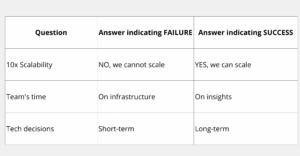
If your organization is considering or struggling with digital transformation, ask yourself these questions:
- Can our current systems handle 10x data growth without major rework?
- Do our teams spend more time managing infrastructure or generating insights?
- Are we making technology decisions based on long-term architecture or short-term features?
The answers will tell you whether you’re building on solid ground or heading toward another failed transformation.
Digital transformation doesn’t have to be a gamble. With the proper architectural foundation, AI becomes what it should be: a powerful accelerator of growth, innovation, and impact.
The question isn’t whether to embrace AI—it’s whether your architecture is ready to make it work.
If you need advice, you can contact us to learn about our success stories and achieve a solid digital transformation.